Access control systems help organizations manage who can enter specific areas, access resources, or perform certain actions. However, not all access control systems work in the same way.
Different organizations have different security requirements, which is why several access control models have been developed. Understanding these models can help businesses choose the right solution for their security needs.
In this guide, we’ll explain the four most common types of access control systems and their typical use cases.
What Is an Access Control Model?
An access control model defines the rules that determine who can access a particular resource or location.
These rules may be based on:
- User roles
- Security policies
- Job responsibilities
- Attributes such as location or department
The right model depends on the level of security and flexibility an organization requires.
1. Discretionary Access Control (DAC)
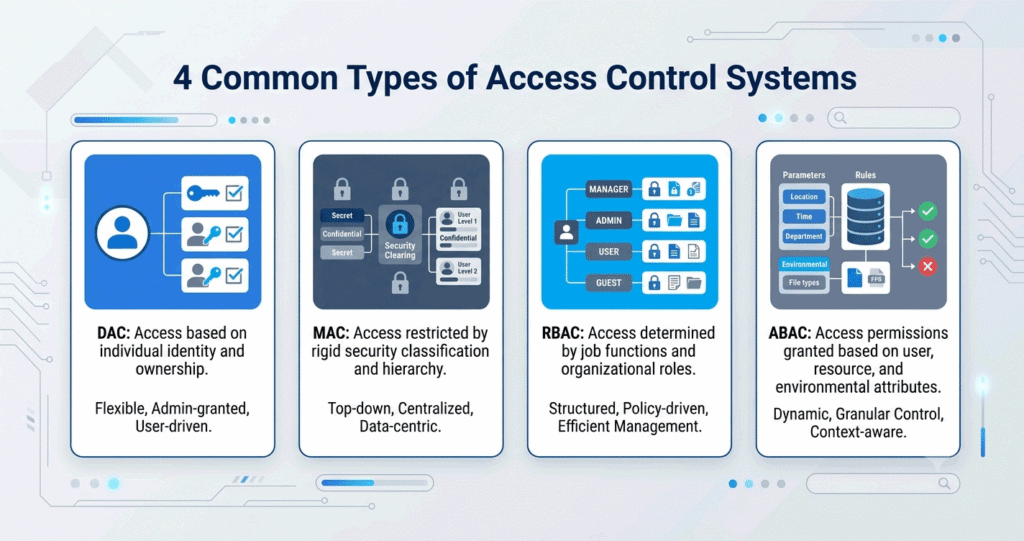
Discretionary Access Control, or DAC, gives resource owners the ability to decide who can access their resources.
For example, a department manager may decide which employees can enter a storage room or access certain files.
Advantages
- Easy to implement
- Flexible permissions
- Suitable for small organizations
Limitations
- Difficult to manage at scale
- Higher risk of permission errors
2. Mandatory Access Control (MAC)
Mandatory Access Control, or MAC, is one of the most secure access control models.
Permissions are determined by strict security policies rather than individual users.
Only administrators can change access rights.
Advantages
- High level of security
- Strong policy enforcement
- Suitable for sensitive environments
Limitations
- Less flexible
- More complex administration
MAC is commonly used in government agencies, military organizations, and high-security facilities.
3. Role-Based Access Control (RBAC)
Role-Based Access Control, or RBAC, is one of the most widely used access control models in business environments.
Access permissions are assigned based on job roles.
For example:
- HR Manager
- IT Administrator
- Employee
- Visitor
When a user changes roles, permissions can be updated automatically.
Advantages
- Easy to manage
- Scalable for growing organizations
- Reduces administrative workload
Limitations
- May require role planning
- Less flexible for unique situations
RBAC is often considered the best option for most businesses.
4. Attribute-Based Access Control (ABAC)
Attribute-Based Access Control, or ABAC, uses multiple attributes to make access decisions.
Examples of attributes include:
- Department
- Location
- Time of day
- Device type
- Security clearance level
Instead of relying only on roles, ABAC evaluates several conditions before granting access.
Advantages
- Highly flexible
- Granular security control
- Supports complex policies
Limitations
- More difficult to configure
- Requires careful planning
ABAC is commonly used in large enterprises with advanced security requirements.
Which Access Control Model Is Best?
There is no single access control model that fits every organization.
Generally:
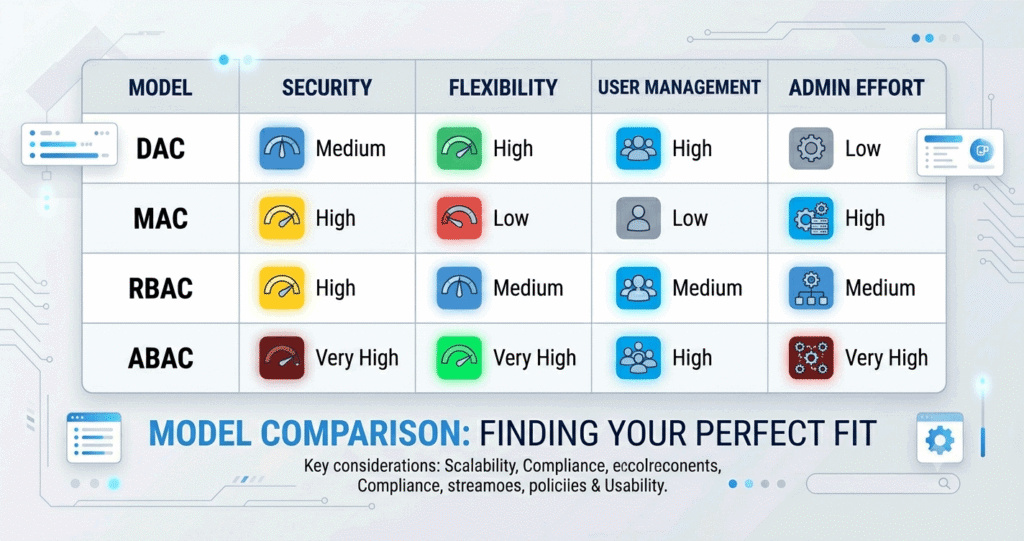
- DAC works well for small environments.
- MAC is ideal for high-security organizations.
- RBAC is suitable for most businesses.
- ABAC provides the greatest flexibility for complex environments.
Organizations should evaluate their security requirements, user structure, and operational needs before choosing a model.
Conclusion
Understanding the different types of access control systems is essential for building an effective security strategy.
DAC, MAC, RBAC, and ABAC each offer unique advantages and challenges. While RBAC remains the most common choice for businesses, organizations with advanced security requirements may benefit from MAC or ABAC models.
Selecting the right access control model can improve security, simplify administration, and support long-term organizational growth.